The most probable meaning of the place name is the Uru (Village) of Maravars, a tribe lived in this area during the turn of Christian Era, who used to attack travelers for looting, hiding in the forest. The word meaning is 'people who hide'. They were traditionally members of the army of tribal chiefs and the Maharajas of Chera, Chola and Pandya. The name Marayur is also said to be derived from two words "mara" and "ur", in Malayalam and Tamil languages. "mara" means hidden and "ur" means land. Another argument is that the name Marayur is derived from the words "mala" and "ur", "mala" means mountain and "ur" means land, hence it was meant to be "the land of the mountains", as the land is surrounded by mountains.
Some scholars toyed with the idea that it can be both "mara" and "mala" as the name Marayur could be interpreted as the land hidden by the mountains.[citation needed] Legend has it the great Pandavas of Mahabharata epic, had stayed in the area during their exile and so the place was named as 'Maranjirunna ur' or the land (they) hide. Later it became the land's name "Marayur." There is no reason to give any credit to the story regarding Pandavas. Mara means cover and Mala means mountain. As such the argument of equivalence of mara and mala is out of question.
Marayur claims to be a part of a Stone Age civilization that is as old as 10,000 B.C. Its is also home to a later period of large-scale dolmen-building. The land and its unique dolmens, caves, rock edicts and engravings declare its rich heritage. People migrated from Tamil Nadu to this area when the Madurai king Thirumalainaicker was defeated by Tippu Sultan, in the eighteenth century CE. Migrated people created five villages which are Kanthalloor, Keezhanthur, Karayur, Marayur and Kottakudi. These villages were called as 'Anju nadu, literally meaning "five lands". However these place names are very old and aboriginal tribes still live in these villages, with their unique customs.
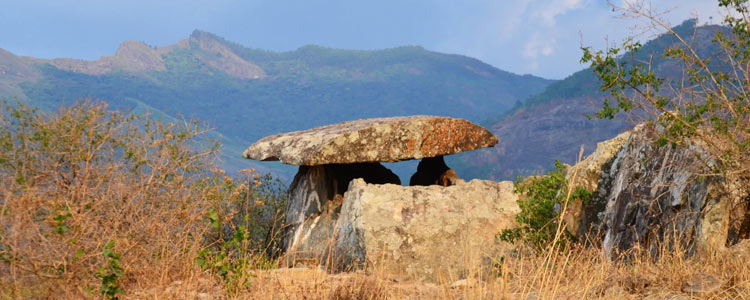 These dolmens belonging to Iron Age is also known as 'Muniyaras'. These are known as burial chambers, made up of four stones, erected on four sides and a fifth stone or cap stone covering the four. As per study, some of these dolmens will have several burial chambers. Around the areas of old Shiva temple (Thenkashinathan temple) at Kovilkadavu, on the banks of Pambar river, you can find dozens of dolmens. These dolmens usually attracts the visitors. Dolmens of Iron age ans Stone age can be found here. Some of them have a height of 70-90 cm and some others have a height of 140-170 cm. You will be excited to find some overground dolmens with a height of 350 cm.
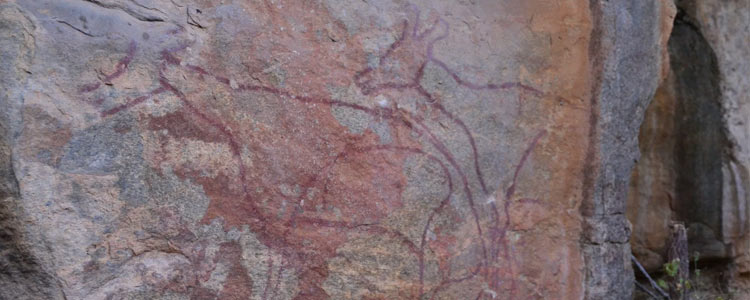 History of Marayoor or Marayur is closely linked with the rock paintings discovered in the Koodakavu Sandalwood Reserve Forest at Marayur. These known as 'Ezhuthu Guha rock paintings' are ancient abstract designs. You can sight some human and animal figures along with around 90 painted motifs. This place one of the most visited rock site in Kerala, which is situated very near to Marayoor or Marayur town. You can find a rock painting at Manala in Chinnar Wildlife Sanctuary too. If you look close, you can find a picture of a deer and a man.
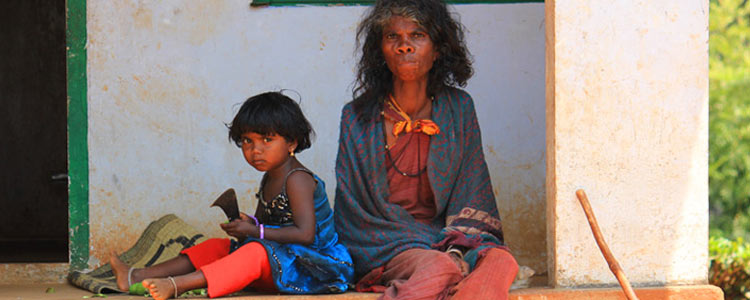 You can find two major tribal groups in Marayoor or Marayur. They are Muthuvans and Hill Pulayas. They still follows their unique tradition and customs. They don't speak Malayalam, in-spite their language is derived from Tamil. They are said to be superstitious, who believes in animism and totem worship. They have their own medicinal system, which consist of mostly plants and herbs.





Separated they live in. A small river named Duden flows by their place and supplies it with the necessary regelialia. It is a paradisematic country
